
Stop Pacing, Start Blocking: The Art of Stage Movement

By Eddie Cortés|Jun 10, 2026|The Art of Speaking
Cover story image

Ask any AV team or event producer what their biggest pet peeve is, and the answer is almost always the same: The Pacer.

You know the speaker. The one who grabs the mic and immediately starts doing laps. Stage left to stage right. Back to stage left. They walk out of the lighting wash, make the camera operator scramble to keep them in frame, and force the audience to watch them like a grueling tennis match.


The Illusion of High Energy

Many speakers confuse pacing with "bringing high energy." But let's be honest among professionals: mindless pacing isn't energy. It’s nervous leakage. It is physical anxiety masquerading as stage presence.

If you want to transition from simply talking on a stage to actually commanding it, you have to stop wandering and start blocking. And nobody teaches this transition better than Michael Port and the team at Heroic Public Speaking.

You Are Not a Speaker. You Are a Performer.

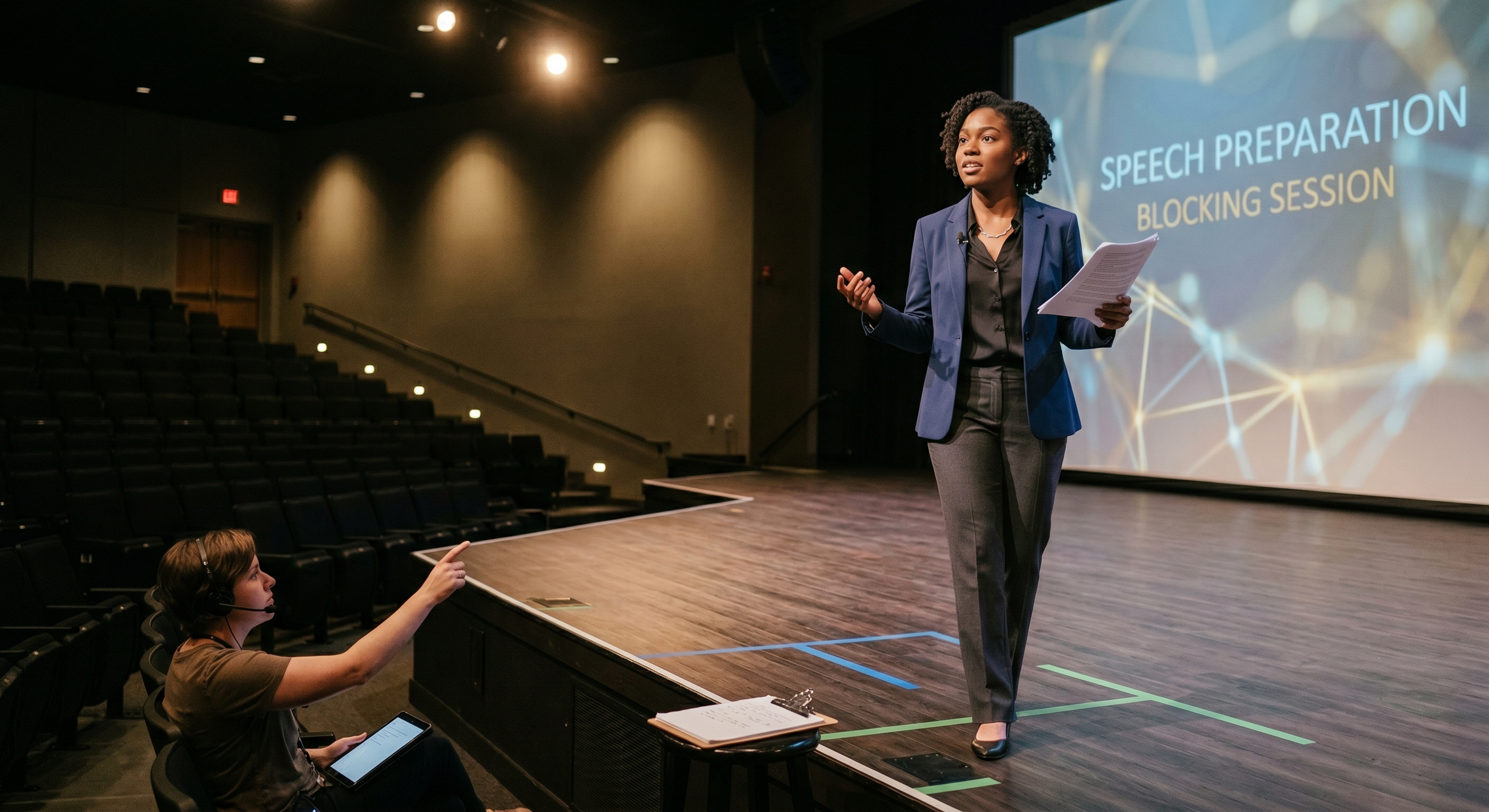
Michael Port’s philosophy bridges the gap between traditional speaking and theatrical performance. In the theater, actors don't just wander around the stage aimlessly while delivering their lines. Every single step, turn, and pause is choreographed. It’s called "blocking."

When you pace the stage, you dilute your power and project nervous energy. But when you plant your feet, deliver a heavy concept, and only move when the narrative demands it, you project absolute authority. Purposeful blocking also makes you an event producer's dream: when you hit your marks, you stay in the light and the production value of the entire event skyrockets.

Section illustration

The Blueprint: How to Block Your Keynote

Stop winging your movement. Treat your stage like a canvas and map out exactly where you need to be. Here is how to build purposeful blocking into your next keynote:

  1. Establish "Home Base"
    Find your dead center. When you walk out to the intro music, hit your center mark and plant your feet. Do not drift. Deliver your entire opening hook from this anchored position. This tells the audience, "I am in control, and you are in good hands." Return to this Home Base whenever you deliver your core thesis or final call to action.

  2. Temporal Blocking (The Timeline Technique)
    The stage has geography, and you can use it to help the audience visualize your concepts. A classic theatrical technique is blocking out time. When you tell a story about the past or the origin of the problem, walk to Stage Right (the audience’s left). When you talk about the present, move to the center. When you cast a vision for the future or the solution, move to Stage Left (the audience’s right). You are physically walking them down a timeline.

  3. Move on the Transition, Plant on the Point
    Never walk while delivering a punchline or a critical insight. Movement is for transitions. Finish your story in one zone of the stage, take a breath, walk to your next mark in silence, plant your feet, and then deliver the next point.

  4. The Power Step (Downstage)
    If you really want to change the energy of the room, stop moving side-to-side and move forward. When you get to the most intimate, vulnerable, or impactful part of your keynote, take two deliberate steps downstage (closer to the edge of the stage, directly toward the audience). It creates a physical intimacy that instantly draws the room in.

The Final Note

Every step you take on a stage should have a reason. If you don't know why you are walking to the left side of the stage, ground your body and plant your feet. Grounding your presence eliminates nervous leakage, allowing your message to do the heavy lifting.

When you learn to treat the stage like a canvas and map your movements with intention, you stop pacing and start blocking. Ground your body, master your transitions, and you will master the room.

Section illustration
Gig Central LogoGig Central

The All-In-One Platform for Your Speaking Business

Perfecting your stagecraft requires rehearsal, discipline, and a clear mind. You can't focus on hitting your marks if you are stressed about double-booked dates or lost invoices. Let an all-in-one platform for professional speakers like Gig Central automate your business operations, so you can spend less time managing the logistics and more time owning the stage.

Try Free →
Sources & Further Reading
  • Heroic Public Speaking (Michael Port): For an absolute masterclass on treating a keynote like a theatrical performance, diving deep into stage blocking, rehearsal discipline, and the mechanics of movement, explore their world-class training programs at heroicpublicspeaking.com.
  • Steal the Show by Michael Port: A highly recommended read for any speaker looking to adopt the mindset of an actor to guarantee a standing ovation.

About the Author

Eddie Cortés
Eddie CortésPRO
High-Energy Speaker • Building Student Resilience

Eddie Cortés is a highly sought-after motivational youth speaker and author of "I’m Possible: A Kid’s Guide To Building Resilience". For over 20 years, Eddie has been on a mission to empower students, transforming his own story as a former at-risk youth into a powerful catalyst for change.